Hotel guest directory: what should it include, on paper or digital?
By Rafael, on
What is a hotel guest directory?
It's the booklet in the room that gathers what guests need during their stay: the hotel's services, opening hours, practical instructions and a few places nearby. It's also called a room directory, a compendium, or a Zimmermappe in German-speaking Switzerland.
Its job is simple: answer questions before they reach reception. A guest who finds the breakfast time or the wifi code alone doesn't queue at the desk, and your team keeps its time for the requests that need a person.
What should a hotel guest directory contain?
The answers to the questions reception hears most, grouped into sections. The table below is a starting point; adapt it to your services.
| Section | What goes in it | How often to update |
|---|---|---|
| Reception | Opening hours, internal number, luggage storage | Rarely |
| Breakfast | Times, location, options | Every season |
| Room | Wifi, heating or air conditioning, safe, TV | Rarely |
| Services | Restaurant, bar, spa, parking, laundry | Whenever hours change |
| Check-out | Check-out time, late check-out, tourist tax | Rarely |
| Safety | Emergency exits, emergency numbers, duty pharmacy | Rarely |
| Neighbourhood | Restaurants, cafés, sights, practical places | Often |
| Getting around | Station, stops, guest card, taxis | Every season |
The last column matters as much as the others: it shows what goes out of date. The sections that change often are the ones that gain most from going digital.
Why do local recommendations matter so much?
Because it's the question reception hears most often, and the one whose answer depends most on who is behind the desk. "Where should we eat tonight?" gets a different answer depending on the team, the time and the mood of the moment.
Written down, your team's recommendations become the same for every guest, available at any hour and in their language. They keep what makes them valuable: a personal sentence saying why you recommend the place.
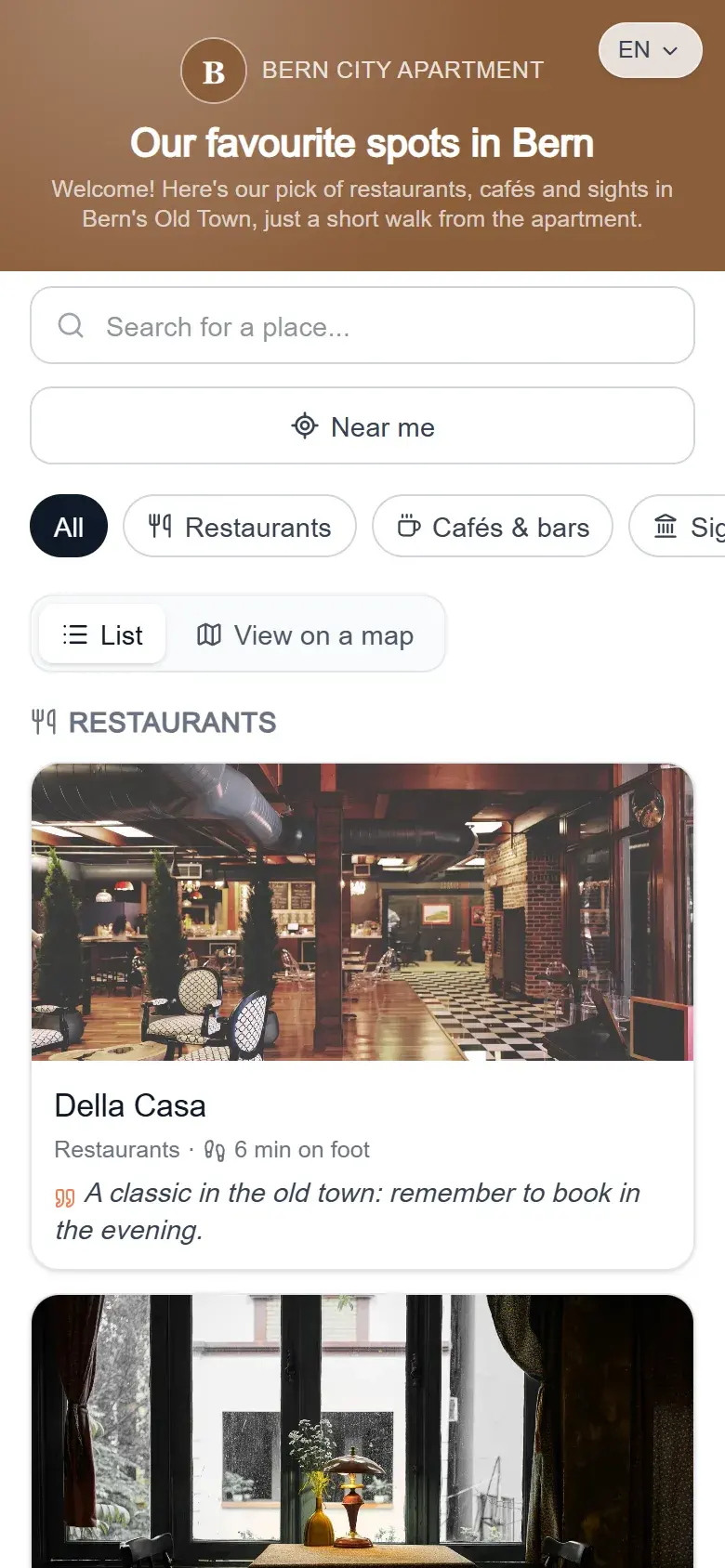
To choose these places, our guide on the best local spots to recommend applies to hotels too: a few places, known by the team, each with a reason.
One detail makes a big difference: the walking time from the hotel. Guests hesitate less to go out when they know the recommended restaurant is six minutes away on foot, rather than "not far".
Paper or digital directory: which should you choose?
Both, each for what it does best. Paper needs no phone and no network, and some guests like leafing through it. Digital updates in an instant, appears in the guest's language and stays accessible before arrival as well as after departure.
- On paper: a one-page card with the essentials, wifi, hours, emergencies, and the QR code.
- In digital form: everything that changes, seasonal services, events, local recommendations.
- Avoid: a twenty-page binder printed once a year, half of which is wrong by July.
The principle is the same as for a holiday rental, covered in our guide to the digital welcome book.
Where should the QR code go in the room?
Where guests sit and naturally look: the bedside table, the desk, next to the TV. At reception, a stand on the counter reaches those arriving; in the lift, those heading out.
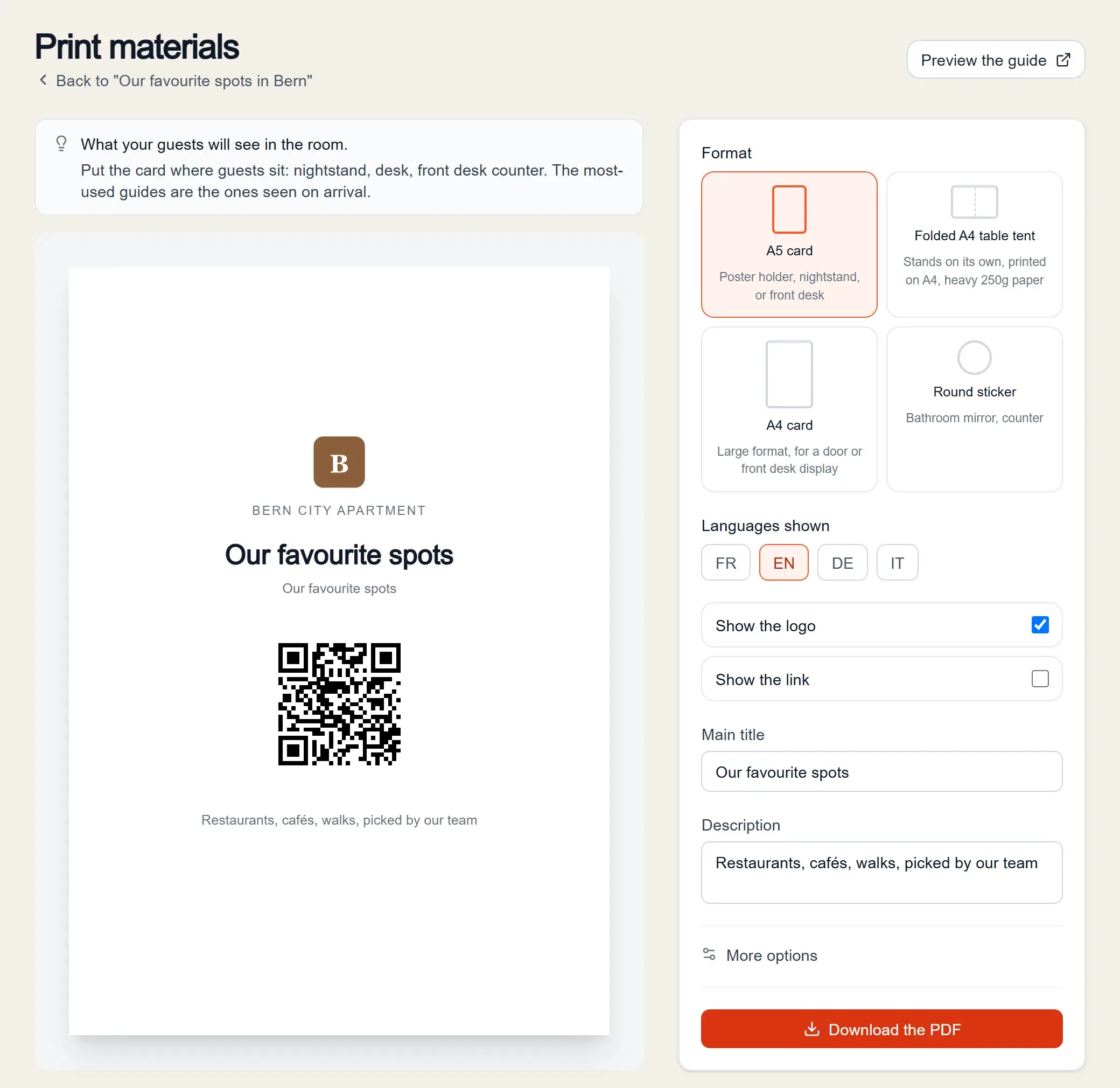
A round sticker on the bathroom mirror works surprisingly well: it's a place everyone passes several times a day. For size, the accompanying text and the mistakes to avoid, see our guide to the guest welcome QR code.
How do you handle languages?
By letting the guide adapt to each guest. A printed directory forces you to choose one or two languages; a digital guide appears in the phone's language and lets guests switch.
In Switzerland, the same hotel welcomes German-, French-, Italian- and English-speaking guests in the same week. HerePicks shows its interface in these four languages and translates your team's texts automatically.
Think too of guests planning their stay: a link sent with the booking confirmation lets them discover the neighbourhood before they even arrive.
Which mistakes should you avoid in a hotel directory?
The same ones come up in many hotels, and each takes a few minutes to fix.
- Copying the website: guests have already read your site; in the room, they want practical answers, not a presentation of the hotel.
- Leaving outdated hours: a wrong breakfast or spa time creates more trips to reception than it saves.
- Putting everything in: twenty pages nobody reads hide the three pieces of information everyone is looking for.
- A single language: guests who can't read it come back to reception, which is exactly what the directory was meant to avoid.
- Places nobody knows: a recommendation the team has never tried doesn't survive the question "have you been there?".
- A QR code with no explanation: write next to it what it opens, for example "Our favourite places nearby".
A good rule: have the directory reread by someone who doesn't know the hotel. Whatever they miss, your guests will look for too.
How do you keep the directory up to date?
- Make one person responsible for each section.
- Review everything when the season changes: hours, services, places.
- Listen to reception: a question that keeps coming back points to missing information.
- Hide a place that closes for winter rather than deleting it.
HerePicks doesn't replace your hotel software: it takes care of the local recommendations around the hotel. The page on the digital guest directory for hotels shows how it fits into your welcome.
Frequently asked questions
What's the difference between a guest directory and a welcome book?
Essentially none: both refer to the information booklet in the room. "Directory" is the term most hotels use, "welcome book" is more common in holiday rentals.
Do you still need a paper directory in the room?
A one-page card is enough, with the wifi, hours, emergencies and the QR code. The rest is better digital, as it changes too often.
Does a digital directory replace reception?
No. It answers simple, repetitive questions, which leaves the team more time for requests that need a person.
Does HerePicks handle room service or spa bookings?
No. HerePicks focuses on local recommendations: restaurants, cafés, sights and practical places, in a guide opened by QR code.
Which languages should the directory be in?
At least those of your most frequent guests. A digital guide adapts to each phone's language; HerePicks covers French, English, German and Italian.
How many pages should a hotel directory have?
On paper, one is enough. In digital form it can be more complete, as long as it's organised by section, with the essentials at the top.
Ready to create your guide?
Free, no credit card required.
Create my guide for free